"Your desert adventure starts with the right questions. Our local team is here to guide you, help you choose the best experience, and make your journey to Erg Chigaga simple and unforgettable."
The difference between the Erg Chebbi and Erg Chigaga deserts lies in their size, location, and accessibility. Erg Chebbi can be reached by small car because the paved road leads to Merzouga, resulting in a large number of tourists and tourist activities. However, Erg Chigaga can only be reached by 4×4 vehicle or camel, as it is about 60 kilometers from M’Hamid. It can also be reached from Foum Zguid in about three hours by 4×4 vehicle. Therefore, there are fewer tourists in Erg Chigaga compared to the Merzouga desert. Erg Chigaga is also larger, quieter, and receives fewer tourists.
You can reach the Erg Chigagaa desert in several different ways, the most common being from the village of M’hamid El Ghizlane. From there, you can use a 4×4 vehicle and cross many sand dunes to reach the site. The journey takes about two hours by 4×4. For those who prefer to explore the desert up close, you can also use camels. A camel tour from M’hamid takes about three days. If you are coming from Foum Zguid, you will also need a 4×4 vehicle. Reaching Erg Chigaga takes about three hours from Foum Zguid
Trekking in the Moroccan deserts is choosing a sensory adventure where silence, light, and immensity resonate with one another. From the undulating dunes of the Sahara to the rocky plateaus, each stage reveals unique landscapes and authentic encounters with nomadic and Berber communities.
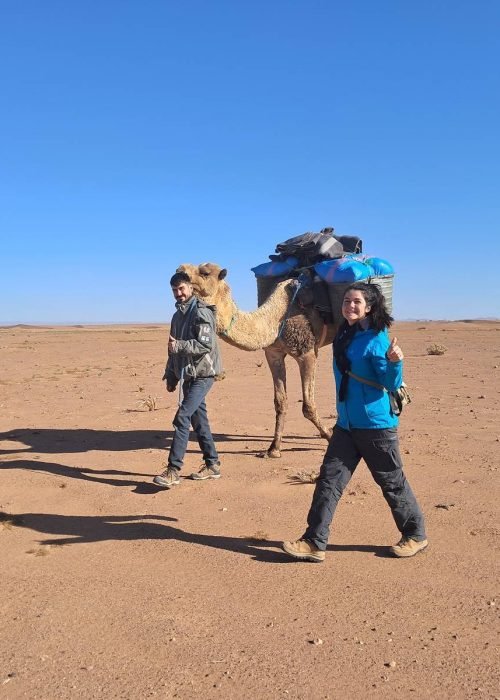
Total Freedom and Immersion: Trekking on foot or camelback allows you to explore remote areas, far from the tourist trails. You move at the pace of the desert, between dunes, regs (stony plains), and oases, and create your own itinerary of wonder.
Guided Comfort and Safety: Our experienced local guides know every route and provide professional support—including bivouac logistics, water supplies, and adherence to weather conditions—to ensure your adventure remains safe and comfortable.
Access to Extraordinary Places: The trek takes you to magical locations—erg Chegaga or Chebbi ergs, secret oases, troglodyte villages—accessible only on foot or in a traditional caravan.
Ideal conditions are generally between October and April, when temperatures are mild during the day and cool at night, making hiking and nights spent camping more pleasant.
October to April: The recommended period for most desert treks—comfortable temperatures, starry nights, and greater safety for longer stages.
May to September: The days can be very hot. It’s best to choose routes at higher altitudes, start very early, and keep the stages short, with shaded breaks and activities in the late afternoon.
A desert trek combines natural exploration with cultural immersion: ever-changing landscapes, unforgettable nights, and authentic encounters.
Majestic Dunes: Climb the most famous ergs—Erg Chebbi or Erg Chigaga—and experience the unforgettable sight of a sunrise or sunset over the sea of sand.
Oases and Palm Groves: Hike to hidden oases where water and greenery contrast with the surrounding aridity—perfect for restorative breaks and encounters with local communities.
Nights in a Bivouac and Stargazing: Sleeping under the open sky, to the sounds of the wind and nomadic music, is often the highlight of the trip. The clarity of the desert sky offers an exceptional display of stars.
Encounters and Culture: Share mint tea with Berber or nomadic families, discover their crafts and stories—a human dimension that enriches every stage of the trek.